
NIRF and NAAC Difference Explained: Ranking vs Accreditation which is better in 2026?
Introduction
India’s higher education ecosystem is evaluated through two nationally mandated mechanisms: National Institutional Ranking Framework (NIRF) and National Assessment and Accreditation Council (NAAC). Both are backed by the Government of India and influence how institutions are perceived, funded, and chosen by students. Yet, they are often misunderstood as interchangeable systems.
This confusion arises because both NIRF and NAAC talk about “quality,” use institutional data, and appear in the same conversations around rankings, admissions, and grants. In reality, they answer very different questions.
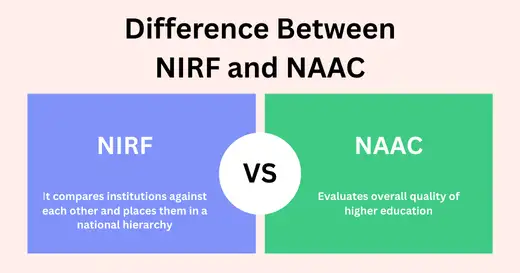
- NIRF is a ranking framework. It compares institutions against each other and places them in a national hierarchy.
- NAAC is an accreditation framework. It certifies whether an institution meets defined quality benchmarks.
Understanding this difference between NIRF and NAAC matters. For students and parents, it shapes college selection. For institutions, it affects reputation, grants, and strategic planning. For policymakers, it ensures accountability, transparency, and sector-wide improvement.
This blog explains the NIRF and NAAC difference clearly, using the latest 2025 frameworks, so each stakeholder knows what to rely on and why.
Competitive performance vs quality assurance
NIRF rewards competitive performance. Institutions gain higher ranks by outperforming peers in teaching resources, research output, graduation outcomes, inclusivity, and perception.
NAAC ensures minimum quality assurance. An institution either meets the benchmark or it doesn’t, regardless of how others perform.
The simplest way to understand it
Think of:
- NIRF as a speedometer: It tells you how fast you are going compared to others on the road.
- NAAC as a quality certificate: It confirms that your vehicle is roadworthy and safe to drive.
An institution can be accredited but not highly ranked. It can also be highly ranked without being accredited. That is why comparing NIRF and NAAC as “better or worse” is misleading. They serve complementary, not competing, roles.
Overview of the NIRF
1. What NIRF Ranking Is
The National Institutional Ranking Framework (NIRF) was launched in 2015 by the Government of India and is currently administered by the Ministry of Education.
Its objective is straightforward but powerful:
- To create a transparent, data-driven, national ranking system.
- To allow fair comparison of higher education institutions across India.
- To replace perception-based claims with measurable performance indicators.
NIRF is conducted annually. Institutions submit verified data every year, and rankings are recalculated fresh each cycle. This makes NIRF dynamic and performance-sensitive.
2. Core NIRF Parameters (2025)
Under NIRF 2025, institutions are evaluated across five broad parameter groups, each contributing to the final score.
- Teaching, Learning & Resources (TLR): Focuses on faculty strength, student intake, infrastructure, and academic resources that directly affect classroom learning.
- Research & Professional Practice (RP): Measures research output, quality, impact, patents, funded projects, and professional consultancy.
- Graduation Outcomes (GO): Assesses student success through examination results, pass percentages, and doctoral output. In discipline-specific rankings, this also includes placement and higher-studies indicators.
- Outreach & Inclusivity (OI): Evaluates diversity, gender balance, regional representation, support for disadvantaged groups, and accessibility.
- Perception (PR): Captures how the institution is viewed by employers, academics, and other stakeholders through structured surveys.
Together, these parameters ensure NIRF measures not just academic performance, but also social responsibility and reputation.
3. NIRF 2025 Methodological Updates
The 2025 framework introduced important refinements aligned with national and global priorities.
- SDG Ranking Category: A dedicated category assessing institutional contribution to the UN Sustainable Development Goals, including environmental and social impact.
- Negative Marking for Retracted Publications: Institutions face penalties for retracted research papers, strengthening research integrity and discouraging unethical practices.
- Sustainability and NEP 2020 Alignment: Greater emphasis on green initiatives, renewable energy use, flexible curricula, multiple entry–exit options, and Indian Knowledge Systems.
- Mandatory Public Data Disclosure: Institutions must host submitted NIRF data on their websites for three years, improving transparency and public scrutiny.
- Expansion of Ranking Categories: Inclusion of more discipline-specific and thematic categories, reflecting the growing diversity of Indian higher education.
These changes position NIRF as not just a ranking tool, but a policy-aligned performance framework.
4. How NIRF Scoring and Ranking Works
NIRF follows a structured, numerical scoring model.
- Score out of 100: Each institution receives a final score calculated from all five parameters.
- Fixed parameter weightages: Each parameter contributes a defined percentage to the overall score, ensuring consistency across institutions.
- Relative ranking logic: Institutions are ranked relative to others in the same category, not against an absolute benchmark.
- Annual validity: Rankings are valid for one year only. Every cycle requires fresh data submission and reassessment.
In practice, this means NIRF rankings can rise or fall every year, reflecting real-time institutional performance rather than long-term certification.
To Understand NIRF Ranking in details: read this blog
To understand in detail about all the NIRF Ranking changes in september 2025: read this blog
Overview of NAAC Binary
1. What NAAC Is
The National Assessment and Accreditation Council (NAAC) operates under the University Grants Commission (UGC) as India’s official institutional quality assurance body for higher education.
NAAC’s core role is not to compare institutions with each other, but to certify whether an institution meets defined national quality standards. Its focus is on governance, academic systems, teaching–learning processes, infrastructure, student outcomes, and long-term sustainability.
Unlike ranking systems, NAAC works on absolute benchmarks:
- If an institution meets the required standards, it is accredited.
- If it does not, it is not accredited.
There is no competition, no national ordering, and no peer-based scoring race. The emphasis is on institutional credibility and quality assurance.
2. NAAC 2025 Reform: Binary + MBGL Framework
In 2025, NAAC introduced its most significant reform to date by replacing the traditional CGPA-based letter grades (A++, A+, A, B, C) with a Binary + MBGL framework.
Key changes include:
- Shift from grades to binary outcomes: Institutions are now first assessed on a simple pass–fail basis.
- Reduction of validity period: Accreditation validity was reduced from five years to three years, increasing accountability and monitoring.
- Two-tier evaluation model:
- Binary Accreditation for baseline quality assurance.
- Maturity-Based Graded Levels (MBGL) for institutions seeking to demonstrate higher maturity and excellence.
This reform moves NAAC from static grading to a continuous improvement-driven framework.
3 Binary Accreditation Explained
Binary Accreditation is the entry-level evaluation under NAAC’s 2025 framework.
- Outcome: Institutions receive one of two results: Accredited or Not Accredited.
- Threshold benchmarks: Accreditation depends on meeting minimum performance thresholds across defined assessment attributes.
- Validity period: Binary Accreditation is valid for three years.
- Reapplication conditions: Institutions that fail to meet benchmarks can reapply after addressing deficiencies, typically after a minimum cooling-off period.
The purpose of Binary Accreditation is to ensure that every accredited institution meets a nationally acceptable baseline of quality, regardless of size or location.
4. Maturity-Based Graded Levels (MBGL)
After securing Binary Accreditation, institutions may opt for Maturity-Based Graded Levels (MBGL) assessment.
MBGL introduces a five-level progression structure:
- Level 1: Foundational
- Level 2: Strengthening
- Level 3: Established
- Level 4: Advanced
- Level 5: Global Excellence
The objective is not labeling, but measuring institutional maturity. Each level represents a stage of institutional evolution, encouraging structured improvement rather than one-time performance.
5. NAAC Assessment Attributes (2025)
NAAC evaluates institutions using an Input–Process–Output (IPO) model, offering a holistic view of quality.
- Input attributes: Curriculum design, faculty resources, infrastructure, financial management.
- Process attributes: Teaching–learning practices, governance, internal quality assurance.
- Output attributes: Student outcomes, research innovation, sustainability impact.
This structure ensures NAAC assesses what an institution has, how it functions, and what it produces.
6. AI-Driven NAAC Assessment Process
The 2025 framework replaces traditional peer visits with an AI-driven evaluation system.
The process includes:
- Digital data submission: Institutions submit all quantitative and qualitative evidence through the NAAC portal.
- AI benchmarking: Submitted data is compared against peer groups and national benchmarks using AI models.
- Stakeholder validation: Inputs from students, alumni, faculty, and employers generate a credibility score, validating institutional claims.
- Threshold comparison and decision: Performance is matched against predefined benchmarks, leading to the final binary outcome.
This approach reduces subjectivity and strengthens transparency and data integrity.
7. Validity, Surveillance, and Renewal
NAAC accreditation follows a structured monitoring cycle:
- 3-year accreditation validity: Applies to both Binary Accreditation and MBGL levels.
- Annual AQAR submission: Institutions must submit Annual Quality Assurance Reports documenting yearly progress and compliance.
- Upgrade and reassessment pathway: Accredited institutions can apply for higher MBGL levels or reassessment before expiry to demonstrate improvement.
NIRF vs NAAC: Head-to-Head Comparison
1. Purpose and Outcome
- NIRF: Focuses on competitive ranking. The outcome is a numerical score and national rank.
- NAAC: Focuses on quality certification. The outcome is Accredited / Not Accredited, with optional MBGL maturity levels.
2. Evaluation Methodology
- NIRF: Quantitative, metrics-driven. Uses normalized scores and fixed weightages. Performance is relative to peer institutions.
- NAAC: Qualitative and holistic. Uses institutional processes, outcomes, and stakeholder validation. Performance is judged against absolute benchmarks.
3. Time Cycle and Validity
- NIRF: Annual rankings. Valid for one year. Requires continuous yearly readiness.
- NAAC: Accreditation cycle of three years. Annual monitoring through AQAR.
4. Institutional Effort and Commitment
- Data submission intensity: NIRF is annual and metrics-focused. NAAC is multi-year and evidence-heavy.
- Governance and stakeholder involvement: NIRF is limited to data validation. NAAC involves deep participation of leadership, IQAC, faculty, and students.
- Monitoring expectations: NIRF offers visibility through rankings. NAAC demands compliance, surveillance, and continuous improvement.
Stakeholder Perspective Analysis
Students and Parents
For students and parents, clarity and trust matter more than technical frameworks.
- NAAC answers the first and most important question: Is this institution academically sound and institutionally reliable? Accreditation assures minimum standards in teaching quality, infrastructure, and governance.
- NIRF helps with comparison: How does this institution perform compared to others nationally? Rankings reveal relative strengths in teaching resources, research output, and reputation.
How stakeholders actually use both: Most families check NAAC status for safety and legitimacy, then use NIRF ranks to shortlist higher-performing options within that trusted pool.
Higher Education Institutions
For institutions, NIRF and NAAC drive two different strategic behaviors.
- NAAC enforces internal discipline. It strengthens governance, curriculum design, IQAC systems, documentation, and long-term sustainability. It is foundational for grants and credibility.
- NIRF creates competitive pressure. It pushes institutions to improve research output, faculty quality, student outcomes, and public perception on a year-on-year basis.
Institutions that focus only on rankings risk weak governance. Institutions that focus only on accreditation risk stagnation. Sustainable growth requires alignment with both.
Policymakers and Funding Agencies
For policymakers, NIRF and NAAC serve complementary oversight roles.
- NAAC ensures baseline quality across the system, including rural and regional institutions, by enforcing minimum standards.
- NIRF highlights excellence, identifies high-performing clusters, and exposes systemic gaps through comparative data.
Together, they support evidence-based policymaking, grant allocation, and sector-wide reforms.
Addressing the “Which Is Better?” Question
1. Is NIRF Better Than NAAC?
The question itself is flawed. NIRF and NAAC are designed to answer different questions, not compete with each other.
- NIRF measures relative performance.
- NAAC certifies absolute quality.
Calling one “better” than the other is like asking whether rankings are better than safety standards. Both are necessary.
2. Can Institutions Have One Without the Other?
Yes. NIRF and NAAC are independent systems.
- Institutions can participate in NIRF without NAAC accreditation (if eligible).
- Institutions can obtain NAAC accreditation without appearing in NIRF rankings.
However, policy direction is shifting. Recent UGC proposals indicate that participation in NAAC accreditation or NIRF rankings may become mandatory for institutions seeking government funding. Strategically, institutions are increasingly expected to engage with both.
3. Why NIRF Is Valid for 1 Year and NAAC for 3 Years
The difference reflects their conceptual purpose.
- NIRF (1-year): Rankings are snapshots of performance. Research output and outcomes can change yearly. Annual validity ensures rankings remain current.
- NAAC (3-years): Accreditation verifies that institutional systems and governance frameworks are in place. These systems are expected to remain stable over time.
Final Verdict: NIRF vs NAAC
The debate between NIRF and NAAC misses a fundamental point: They were never designed to compete.
- Students need NAAC to trust an institution’s quality and NIRF to judge its competitive standing.
- Institutions need NAAC to build strong internal systems and NIRF to demonstrate excellence.
- Regulators rely on NAAC for system-wide quality and on NIRF to identify performance leaders.
The correct approach is not choosing one over the other, but using both together to understand quality, performance, and progress in a holistic way.
NIRF vs NAAC:
- NIRF is an annual ranking system measuring relative performance.
- NAAC is a triennial accreditation system ensuring absolute quality assurance.
NIRF and NAAC’s 2025 Reforms and Their Impact
- NIRF 2025: Introduced SDG-based evaluation, stricter research integrity norms (retraction penalties), and sustainability metrics.
- NAAC 2025: Shifted to Binary Accreditation (Accredited/Not Accredited) with MBGL progression and reduced validity periods.
- Both reforms emphasize transparency, accountability, and continuous improvement.
Strategic Importance
Institutions that rely only on NAAC risk invisibility. Those that chase only NIRF risk weak governance. Long-term credibility now depends on alignment with both frameworks.
NAAC builds the foundation. NIRF tests performance on that foundation. Institutions that succeed in both earn trust, visibility, and relevance.
Simplify your NAAC and NIRF Rankings
Accreditation and ranking are no longer one-time exercises. They are continuous, data-heavy, and audit-sensitive.
That’s exactly where Ki-NAAC and Ki-NIRF fit in.
- Ki-NAAC helps institutions stay Binary-ready and MBGL-progressive by structuring evidence, mapping IPO attributes, automating AQAR workflows, and maintaining year-round quality compliance.
- Ki-NIRF simplifies annual ranking readiness by centralising parameter-wise data, tracking eligibility, validating metrics, and ensuring public data transparency without last-minute chaos.
Used together, they create a single operational backbone for both quality assurance and competitive performance.
If NAAC builds your foundation and NIRF tests your performance, Ki-NAAC and Ki-NIRF make sure neither breaks under pressure.