
2-hour Live AI Masterclass For Non-Coders
NAAC Binary Accreditation 2025: A Revolutionary Era in Higher Education Assessment
By, Kramah Team

On February 10, 2025, NAAC officially announced these significant reforms. The National Assessment and Accreditation Council (NAAC) has introduced a groundbreaking shift in how higher education institutions in India are evaluated. The Binary Accreditation model is expected to be rolled out in April-May 2025, followed by the introduction of Maturity-Based Graded Levels (MBGL).
NAAC will deploy an AI-driven system that replaces traditional peer review processes. This revolutionary approach eliminates the complexity of CGPA-based grades, replacing them with a transparent binary status: Accredited or Not Accredited.
What Is NAAC Binary Accreditation 2025?
The NAAC reform 2025 introduces a fully digital, data-driven, and validation-based accreditation workflow. Under this transformative framework:
- AI-Powered Assessment: AI-based assessment replaces traditional physical peer visits.
- Binary Classification: Binary accreditation classifies institutions into two categories: Accredited or Not Accredited. Unlike the old grading system that assigns grades, like A++ or B, this system provides a decisive accreditation status.
- Digital-First Process: Institutions submit all evidence and data digitally via the NAAC portal. The AI engine benchmarks institutional data against peer groups and national averages.
- Stakeholder Validation: NAAC conducts a digital stakeholder validation survey. Around 100 stakeholders, including students, alumni, faculty, employers, and administrative staff, are selected randomly to provide feedback on institutional data.
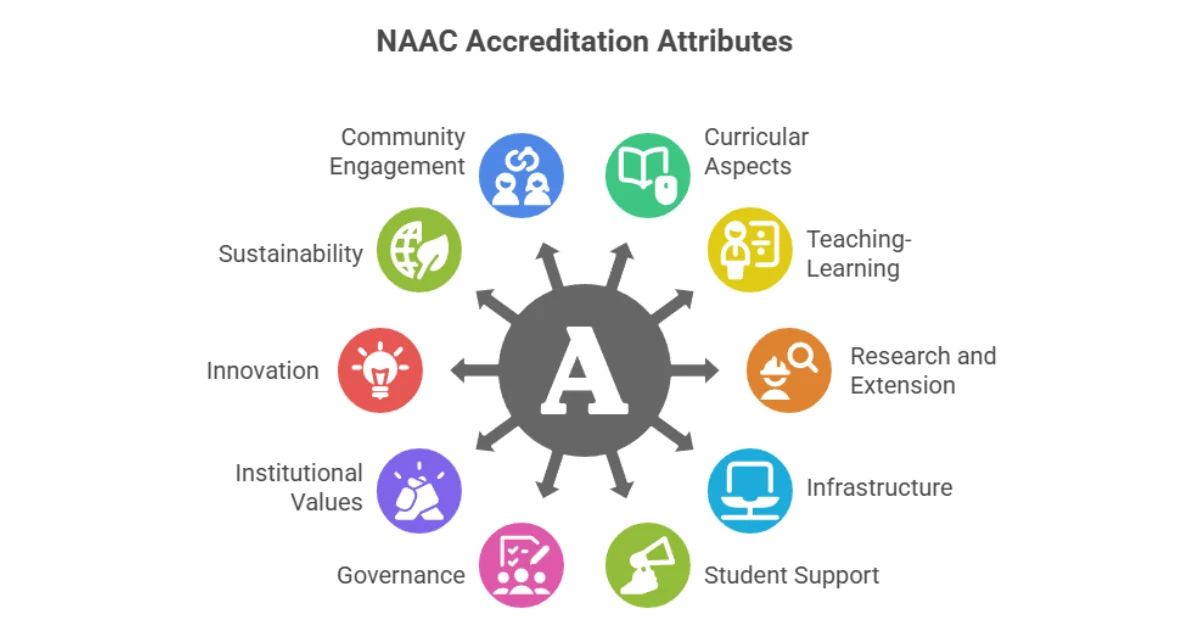
The 10 Key Attributes of NAAC Binary Accreditation 2025
Under the new framework, institutions are evaluated based on 10 key attributes, which encompass various aspects of institutional functioning. These attributes serve as the foundation for the accreditation process:
These attributes are arranged across three clear layers; Inputs, Processes, and Outcomes to evaluate what an institution has, how it works, and what it actually delivers.
Input Attributes (1-3):
- Curricular Aspects – Dynamic curriculum aligned with industry needs and global trends
- Teaching-Learning and Evaluation – Faculty qualifications, pedagogical methods, and assessment strategies
- Research and Extension – Research infrastructure, publications, and community outreach
Process Attributes (4-7):
- Infrastructure and Learning Resources – Physical and digital infrastructure quality
- Student Support and Progression – Student services, career guidance, and placement support
- Governance, Leadership, and Management – Institutional governance structures and leadership effectiveness
- Institutional Values and Best Practices – Ethics, transparency, and innovative practices
Outcome Attributes (8-10):
- Innovation and Best Practices – Creative initiatives and knowledge dissemination
- Sustainability and Environmental Impact – Green practices and environmental consciousness
- Community Engagement and Outreach – Social responsibility and community partnerships
The allocation of weightage will be 25% for Input and 75% for Process & Output.
AI-Powered Assessment Framework
This technology analyzes vast institutional data points to generate objective and consistent accreditation outcomes. The AI model promises to reduce evaluation time and human biases, offering a transparent and efficient pathway for institutions seeking accreditation.
Key Features of AI Assessment:
- Credibility Scoring: Institutions will start with a credibility score of 0.5, adjustable by stakeholder panels.
- Threshold Benchmarks: Each HEI must meet a minimum threshold benchmark—for instance, 40% for colleges, 50% for autonomous institutions, and 60% for universities—to move forward in the accreditation cycle.
- Cross-Platform Validation: The new NAAC system performs auto-validation using UDISE+, AISHE, and NIRF data.
Maturity-Based Graded Level (MBGL) System
Institutions that achieve Binary Accreditation can progress to MBGL—Maturity-Based Graded Levels, a new model that evaluates continuous improvement beyond compliance.
The MBGL framework classifies institutions into five maturity levels:
- Level 1: Basic – Meeting minimum standards with improvement opportunities
- Level 2: Developing – Demonstrating progress and system strengthening
- Level 3: Established – Stable practices with consistent performance
- Level 4: Advanced – Innovation leadership with national presence
- Level 5: Institutions of Global Excellence—International standards with global impact
Assessment Methodology by Level:
Level 1–2: Fully digital assessment. Level 3: Hybrid assessment (digital + sample physical verification). Level 4–5: Comprehensive review with on-site validation and expert interaction.
Eligibility and Application Requirements 2025
Basic Eligibility:
The HEI must have been completed at least 4 years of establishment or have one graduating batch of students. Eligible categories include universities, autonomous colleges, affiliated colleges, and constituent colleges recognized by UGC.
Data Preparation Requirements:
Institutions must maintain digital records of academic, administrative, and financial data aligned with NAAC’s new Data Capture Formats (DCF 2025).
One Nation One Data Platform
The validation system in the One Nation One Data Platform and the diverse categories for institutions indicate that NAAC is breaking all the one-size-fits-all techniques for better, friendlier procedures that the institutions deserve. This platform ensures data integrity and enables cross-verification of institutional claims.
Comparison: Old NAAC vs Binary Accreditation 2025
| Aspect | Old CGPA System | Binary Accreditation 2025 |
|---|---|---|
| Grading | A++ to D (CGPA scale) | Accredited / Not Accredited |
| Assessment | 7 criteria | 10 attributes (Input-Process-Output) |
| Evaluation Method | Physical peer visits (30%) | AI-powered digital assessment |
| Timeline | 12-18 months | Binary accreditation may take just a few months if documents are ready |
| Reporting | Manual documentation | Automated digital workflows |
| Coverage | Only 40% of Indian universities and 18% of colleges were accredited | NAAC aims to accredit over 90% of India’s HEIs under this new model within five years |
Critical Changes Institutions Must Adapt To
1. Continuous Compliance Monitoring
Institutions must adapt to stricter compliance, evidence-based evaluation, and continuous improvement. Accreditation is now a year-round activity requiring:
- Real-time data updates
- Automated evidence collection
- Regular self-assessment protocols
2. Evidence-Based Documentation
The binary system is built on one demand: irrefutable evidence. Every metric requires:
- Verifiable digital documentation
- Cross-platform data consistency
- Complete audit trails
3. Outcome-Based Assessment Focus
The reforms emphasize outcome-based assessment, evaluating the effectiveness of teaching and learning, research output, and overall institutional impact.
Transition Pathways for Existing Institutions
For HEIs in Cycle 2 and Above:
HEIs currently in Cycle 2 and beyond the existing RAF will be allowed to retain the validity of their present grade until the Basic Accreditation and MBGL are officially launched.
For First-Time Applicants:
For HEIs in Cycle 1 under the RAF, there will be an option to opt for basic accreditation.
Assessment Mode Options:
HEIs that prefer to proceed with the accreditation process under the existing RAF system will undergo peer team assessments through either online mode for colleges or hybrid mode for universities.
Technology Integration with Kramah KI-NAAC Software
The digital transformation demands sophisticated technology solutions. Kramah Software’s Ki-NAAC addresses critical preparation needs:
Core Features:
- Automated Attribute Mapping: Documents aligned directly to the 10 key attributes
- AI-Driven Gap Analysis: Real-time compliance monitoring and predictive readiness indicators
- One-Time Data Entry: Unified system for AQAR, SSR, and Binary submissions
- Cross-Framework Alignment: Compatible with NAAC, NBA, NIRF, and OBE requirements
- Stakeholder Management: Automated notifications and workflow coordination
Performance Impact:
Early adopters report faster turnaround times and clearer improvement guidance from MBGL reports. Institutions using advanced preparation software report up to 40% faster submission times and significantly fewer compliance errors.
Preparation Strategy for 2025 Implementation
Immediate Actions (Next 3 Months):
- Digital Infrastructure Setup: Ensure your institution maintains comprehensive, up-to-date digital records.
- Staff Training Programs: Familiarize your quality assurance teams with AI-based evaluation practices.
- Data Consistency Audits: Align all institutional data with UDISE+, AISHE, and NIRF databases
Medium-Term Preparation (6-12 Months):
- IQAC Restructuring: Strengthen internal quality assurance mechanisms
- Evidence Documentation: Create comprehensive digital repositories
- Stakeholder Engagement: Communicate transparently with students, faculty, and administration about accreditation changes.
Current Statistics and Impact Projections
- Implementation Timeline: April-May 2025 for Binary Accreditation
- Expected Coverage: NAAC aims to accredit over 90% of India’s HEIs under this new model within five years
- Processing Speed: The AI system is still in pilot stages but shows promising accuracy and speed improvements. Early adopters report faster turnaround times
- Fee Structure: Reduced costs due to elimination of physical visits
Conclusion
On February 10, 2025, NAAC officially announced these significant reforms. The NAAC Binary Accreditation system represents the most significant transformation in Indian higher education quality assurance. This shift simplifies accreditation, reduces subjectivity, and encourages more institutions, especially smaller and regional ones, to participate. By replacing complex peer evaluations with AI-based assessments and stakeholder validation, NAAC aims to accelerate accreditation, make it fairer, and make it more transparent.
The Binary Accreditation Framework marks a significant leap forward in improving the standards of Higher Educational Institutions (HEIs) across India. This framework will empower HEIs to continuously improve, ensuring that they not only provide quality education but also prepare students to thrive in an increasingly complex and interconnected world.
For institutions preparing for this transition, the key to success lies in embracing digital transformation, maintaining rigorous evidence standards, and focusing on continuous improvement across all 10 attributes. The binary era rewards institutions that are organized, transparent, and data-precise.
👉 Book a demo with Kramah Software today to ensure your institution is fully prepared for NAAC binary accreditation in 2025.
For more detailed information, institutions can refer to the official NAAC documents and guidelines available on the NAAC website.
FAQ's:
(Frequently Asked Questions)
What are the 10 new criteria for NAAC accreditation?
The 10 attributes include Curricular Aspects, Teaching-Learning & Evaluation, Research & Extension, Infrastructure & Learning Resources, Student Support & Progression, Governance & Leadership, Institutional Values, Innovation & Best Practices, Sustainability & Environmental Impact, and Community Engagement & Outreach.
How long does the new binary accreditation process take?
Binary accreditation may take just a few months if documents are ready; MBGL levels may take longer.
What is MBGL in NAAC?
MBGL stands for Maturity-Based Graded Levels, a new layered rating from Level 1 to Level 5 that institutions can opt into after basic accreditation.
Are physical peer team visits eliminated?
Physical peer team visits will be eliminated for basic accreditation. Evaluation will be based on document verification, live video interactions, and AI-based scoring.
What happens to existing RAF accreditations?
HEIs currently in Cycle 2 and beyond the existing RAF will be allowed to retain the validity of their present grade until the Basic Accreditation and MBGL are officially launched.
What are the eligibility requirements for binary accreditation?
The HEI must have completed at least 4 years of establishment or have one graduating batch of students. Eligible categories include universities, autonomous colleges, affiliated colleges, and constituent colleges recognized by UGC.
How does AI assessment work in the new system?
The AI engine benchmarks institutional data against peer groups and national averages. Institutions will start with a credibility score of 0.5, adjustable by stakeholder panels.
What is the weightage distribution in the new system?
The allocation of weightage will be 25% for input and 75% for process & output.
Can institutions directly apply for MBGL?
HEIs with a valid RAF accreditation and strong performance metrics can directly move into the MBGL assessment stage. Institutions demonstrating consistent excellence can skip the Binary evaluation entirely.
What data management changes are required?
Institutions must maintain digital records of academic, administrative, and financial data aligned with NAAC’s new Data Capture Formats (DCF 2025).