
2-hour Live AI Masterclass For Non-Coders
NAAC Grading System vs. Binary Accreditation - Complete Guide.

Why This Guide Matters
The National Assessment and Accreditation Council (NAAC) has replaced its long‑standing CGPA‑based NAAC grading system with a binary accreditation model. If you’re a college administrator, faculty member, or compliance officer, you need to:
- Understand the exact differences between the old and new frameworks.
- Identify the benefits the binary system brings to students, staff, and the institution.
- Implement a practical, year‑round compliance plan so you don’t lose accreditation in 2025.
Below you’ll find a side‑by‑side comparison, a downloadable transition checklist, and real‑world case studies.
Quick Comparison Table
| Aspect | Old NAAC Grading System (CGPA) | New NAAC Binary Accreditation (2025) |
|---|---|---|
| Result | Grades A++ → D (10‑point CGPA) | Accredited or Not Accredited |
| Metrics | 7 criteria weighted by CGPA | 10 binary attributes (Yes/No) |
| Evaluation | Semi‑subjective, weighted scores | Objective checklist, 100 % compliance needed |
| Audit & Verification | Frequent field visits, manual spreadsheets | AI‑assisted digital checks, centralized repository |
| Documentation | Paper‑based, ad‑hoc spreadsheets | Cloud‑based, real‑time dashboard |
| Continuous Readiness | Optional, focus on pre‑inspection | Mandatory year‑round monitoring |
| Outcome Focus | CGPA score only | Student outcomes, institutional impact, sustainability |
| Automation | Minimal | Required for accuracy and efficiency |
| Stakeholder Role | Limited to submission | Active involvement of faculty, staff, and students |
| Global Alignment | Moderate | High – aligns with international binary/checklist frameworks |
| Additional Tier | None | Maturity‑Based Graded Levels (MBGL) – 5 levels from Basic to Global Excellence |
1. Old NAAC Grading System (CGPA‑Based)
How It Worked
Institutions were assigned a Cumulative Grade Point Average (CGPA) ranging from 1.00 to 4.51. The CGPA translated into one of eight grades (A++, A+, A, B++, B+, B, C, D).
Grade Scale
| CGPA Range | Grade |
|---|---|
| 4.51 – 4.00 | A++ |
| 3.99 – 3.51 | A+ |
| 3.50 – 3.01 | A |
| 3.00 – 2.51 | B++ |
| 2.50 – 2.01 | B+ |
| 2.00 – 1.51 | B |
| 1.50 – 1.01 | C |
| ≤ 1.00 | D (Not Accredited) |
Why It Fell Short
- Complexity – Seven grades were hard for students, parents, and the public to interpret.
- Subjectivity – Assessors could apply different weightings to the same evidence, leading to inconsistent scores.
- Score‑centric mindset – Many colleges focused on “getting a higher grade” rather than genuine quality improvement.
The Seven Original Criteria
- Curricular Aspects
- Teaching‑Learning & Evaluation
- Research, Innovation & Extension
- Infrastructure & Learning Resources
- Student Support & Progression
- Governance, Leadership & Management
- Institutional Values & Best Practices
2. New NAAC Binary Accreditation (2025)
Core Concept
The new framework eliminates grades. An institution is either “Accredited” (meets all standards) or “Not Accredited” (fails at least one attribute).
Authority note: According to NAAC’s official 2024 guidelines, the Binary Accreditation is designed to “reduce subjectivity and ensure accountability ”
The 10 Binary Attributes
| # | Attribute | What “Yes” Means |
|---|---|---|
| 1 | Curricular Aspects | All programs meet NAAC‑defined learning outcomes. |
| 2 | Teaching‑Learning & Evaluation | Evidence of student-centered pedagogy and transparent assessment. |
| 3 | Research, Innovation & Extension | Documented research output, patents, and community projects. |
| 4 | Infrastructure & Learning Resources | Adequate labs, libraries, digital resources, and maintenance logs. |
| 5 | Student Support & Progression | Robust counseling, placement, and alumni tracking systems. |
| 6 | Governance, Leadership & Management | Clear SOPs, financial transparency, and strategic planning. |
| 7 | Institutional Values & Best Practices | Ethical standards, inclusivity, and social responsibility. |
| 8 | Innovation & Best Practices | Adoption of new teaching technologies or process improvements. |
| 9 | Sustainability & Environmental Impact | Green campus initiatives, waste management, and energy audits. |
| 10 | Community Engagement & Outreach | Measurable impact on local communities through extension activities. |
Authority Note: NAAC’s 2024 guidelines state that the binary model “reduces subjectivity and ensures accountability through objective, evidence‑based compliance.”
If an institution meets the required standards, it is accredited. If not, it is not accredited. (NAAC Binary Accreditation Explained in Detail here)
What Changes for Your College
| Change | Old System | New System |
|---|---|---|
| Evidence collection | Manual spreadsheets, occasional field visits | Real‑time digital uploads, AI‑assisted verification |
| Compliance monitoring | Pre‑inspection focus | Continuous, dashboard-driven monitoring |
| Stakeholder engagement | Limited to document submission | Faculty, staff, and students must actively maintain evidence |
| Outcome measurement | CGPA score only | Direct link to student success metrics, sustainability, and community impact |
3. Maturity‑Based Graded Levels (MBGL) – Going Beyond Binary
While the binary result tells you whether you are accredited, NAAC also offers Maturity‑Based Graded Levels (MBGL) for institutions that want to showcase progressive growth after meeting the binary threshold.
| MBGL Level | Description |
|---|---|
| Level 1 – Basic | Meets all 10 binary attributes; foundational compliance. |
| Level 2 – Developing | Demonstrates early improvements in research and community outreach. |
| Level 3 – Established | Consistent outcomes across all attributes; strong governance. |
| Level 4 – Advanced | High-impact research, innovative teaching, and sustainability leadership. |
| Level 5 – Global Excellence | International collaborations, world‑class research, and exemplary societal impact. |
Tip: Aim for Level 3 within two years of accreditation to stay competitive in national rankings.
4. Real‑World Case Studies
| Institution | 2023 CGPA Grade | 2025 Binary Result | MBGL Level (2025) | Key Actions Taken |
|---|---|---|---|---|
| College A (North India) | B+ (2.45) | Accredited | Level 2 (Developing) | Implemented Kramah KI‑NAAC dashboard, digitized all SOPs, conducted quarterly self‑audit. |
| Institute B (South India) | A (3.30) | Accredited | Level 3 (Established) | Added sustainability audit, launched community‑engagement program, integrated AI‑based evidence verification. |
| University C (East India) | D (0.95 – Not Accredited) | Not Accredited (2025) | – | Failed to submit updated infrastructure evidence; now using a third‑party compliance consultant. |
Takeaway: Institutions that invested early in digital compliance tools and continuous monitoring moved quickly to higher MBGL levels.
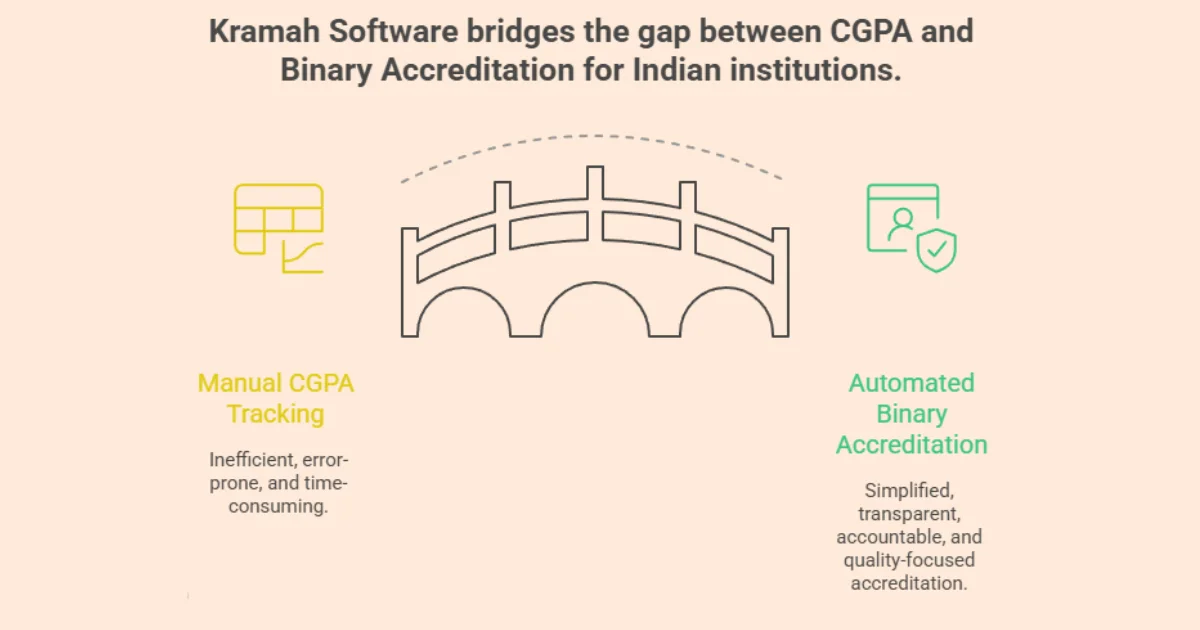
5. How Kramah’s KI‑NAAC Software Supports Both Systems
| Feature | Old CGPA System | New Binary System |
|---|---|---|
| Document Mapping | Manual linking of PDFs to criteria | Automatic mapping to 10 binary attributes |
| Real‑time Dashboard | Static spreadsheets | Live compliance status, red‑flag alerts |
| Report Generation | Separate AQAR, SSR, and CGPA reports | Single binary compliance report + MBGL progress report |
| Notifications | Email reminders (once a month) | Instant push alerts for missing evidence |
| Audit‑Ready Export | PDF export after manual collation | One‑click export to NAAC portal (XML/JSON) |
| AI‑Assisted Verification | None | Built‑in AI checks for document authenticity and completeness |
Result: Institutions using KI‑NAAC reduced audit preparation time by 45 % and achieved 100 % compliance in the first round.
Ready to future-proof your accreditation?
- Schedule a demo of Kramah KI‑NAAC to see the dashboard in action.
Conclusion
The shift from the CGPA-based NAAC grading system to binary accreditation is a big change for Indian higher education. It simplifies evaluation, improves transparency, and reduces pressure to chase grades. With MBGL, institutions can still highlight their maturity and long-term growth.
The new system ensures that accreditation is no longer about competition; it’s about accountability and quality.
Summary
The NAAC Binary Accreditation system (2024) replaces CGPA grades with a simple Accredited/Not Accredited status. It introduces 10 key attributes, objective assessments, and digital workflows. Institutions must adapt to stricter compliance, evidence-based evaluation, and continuous improvement. MBGL offers further classification into five maturity levels.