
NAAC vs NIRF: The Key Differences Between NAAC and NIRF (2025 Guide)
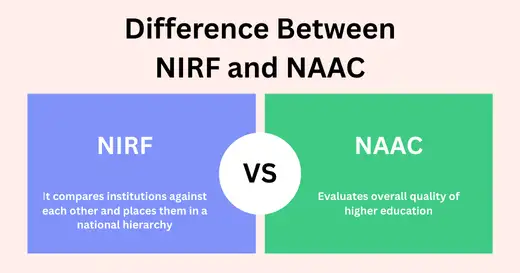
India’s higher education landscape is governed by two critical pillars: the National Institutional Ranking Framework (NIRF) and the National Assessment and Accreditation Council (NAAC).
While both are backed by the Government of India and essential for institutional quality, they serve fundamentally different purposes. NIRF answers, “How does this college compare to others?” whereas NAAC answers, “Is this college quality certified?”
With the introduction of the NAAC Binary Accreditation & MBGL system in 2025, the distinctions have become even sharper. This guide breaks down the difference between NAAC and NIRF, covering their full forms, purposes, and the latest regulatory updates.
NAAC vs NIRF: At a Glance
For students and parents trying to make a quick decision, here is the fundamental difference:
| Feature | NIRF (Ranking) | NAAC (Accreditation) |
|---|---|---|
| Full Form | National Institutional Ranking Framework | National Assessment and Accreditation Council |
| Primary Goal | Competitive Ranking | Quality Assurance & Certification |
| Outcome | A Rank (e.g., Rank #1, #10) | A Status (Accredited/Not Accredited) or Maturity Level |
| Basis | Relative performance (compared to peers) | Absolute benchmarks (meets set standards) |
| Validity | 1 Year | 3 Years |
| Analogy | Like a Speedometer (shows speed relative to others) | Like a Quality Certificate (confirms the vehicle is roadworthy) |
The Core Concept: Ranking vs. Accreditation
The confusion between NAAC and NIRF stems from the fact that both deal with “quality.” However, their mechanisms differ:
NIRF is competitive: it rewards institutions that outperform their peers in teaching, research, and graduation outcomes. Your rank depends on how others perform. If everyone improves, your rank might drop even if your score improves.
NAAC is absolute: it certifies whether an institution meets a defined standard of quality. An institution is either accredited or it is not. It does not matter if another college is better; if you meet the benchmark, you are certified.
Overview of NIRF (2025 Framework)
What is NIRF?
Launched in 2015 by the Ministry of Education, the National Institutional Ranking Framework (NIRF) is an annual exercise. It ranks institutions based on objective data to help students make informed choices.
Key Parameters (2025)
NIRF evaluates institutions across five broad parameters, with specific weightages for different categories (Engineering, Management, Universities, etc.):
- Teaching, Learning & Resources (TLR): Faculty strength, student-faculty ratio, and infrastructure.
- Research and Professional Practice (RP): Publications, patents, and funded projects.
- Graduation Outcomes (GO): Placement records, higher studies, and passing percentages.
- Outreach and Inclusivity (OI): Gender diversity, regional representation, and support for economically disadvantaged students.
- Perception (PR): Peer perception based on surveys from employers and academics.
What’s New in NIRF 2025?
The 2025 framework has introduced key changes to align with global standards:
- SDG Ranking: A specific category for Sustainable Development Goals (SDG) impact.
- Research Integrity: Negative marking for retracted publications to discourage unethical practices.
- Mandatory Transparency: Institutions must host submitted data on their websites for three years for public scrutiny.
Overview of NAAC (2025 Binary & MBGL Framework)
What is NAAC?
Operating under the UGC, the National Assessment and Accreditation Council (NAAC) assesses the “Quality Assurance” of institutions. Unlike NIRF, NAAC does not rank colleges; it grades their internal systems and governance.
Major Reform: The 2025 Binary System
In 2025, NAAC overhauled its grading system. The old letter grades (A++, A+, B, etc.) were replaced with a Binary + MBGL framework.
1. Binary Accreditation (The Entry Gate)
This is the first level of assessment. The outcome is simple: Accredited or Not Accredited.
- Focus: Meets minimum quality benchmarks.
- Validity: 3 Years.
- Process: AI-driven data submission and benchmarking against peer groups.
2. Maturity-Based Graded Levels (MBGL)
Only institutions that secure Binary Accreditation can opt for MBGL to demonstrate higher maturity. This consists of five progressive levels:
- Level 1: Foundational
- Level 2: Strengthening
- Level 3: Established
- Level 4: Advanced
- Level 5: Global Excellence
This shift moves NAAC from a static “grading” exercise to a continuous “improvement” model.
How NAAC Assessment Works (2025)
- Input-Process-Output (IPO) Model: NAAC evaluates what the institution has (Input), how it teaches (Process), and what students achieve (Output).
- AI & Stakeholder Validation: The system uses AI to validate data against benchmarks, while stakeholder feedback (students, alumni, and employers) determines the credibility score.
Detailed Comparison: NIRF vs NAAC
To understand which framework matters more for you, let’s compare them across specific metrics.
1. Evaluation Methodology
- NIRF: Highly quantitative. It relies on verifiable data like publication numbers, salary packages, and exam pass percentages.
- NAAC: Qualitative and holistic. It evaluates curriculum design, internal quality assurance systems (IQAC), governance, and student support mechanisms.
2. Validity and Effort
- NIRF: Rankings are valid for only one year. Institutions must submit data annually to maintain or improve their rank.
- NAAC: Accreditation is valid for three years. However, institutions must submit Annual Quality Assurance Reports (AQAR) every year.
3. Impact on Stakeholders
For Students:
- Use NAAC to shortlist safe, credible colleges (checking if they are “accredited”).
- Use NIRF to pick the best college among the accredited ones (checking the rank).
For Institutions:
- NAAC builds the foundation (governance, systems, and culture).
- NIRF provides the visibility (marketing, branding, and competitive standing).
Simplify Your Compliance: Ki-NAAC and Ki-NIRF
Whether you are an institution striving for NAAC Binary Accreditation or aiming for a Top 10 NIRF Rank, the process is data-heavy and audit-sensitive.
This is where our solutions help:
- Ki-NAAC: Helps you stay binary-ready by mapping evidence to the IPO model, automating AQAR workflows, and preparing you for MBGL maturity levels.
- Ki-NIRF: Centralizes your parameter-wise data, validates metrics for research and graduation outcomes, and ensures you meet the public data disclosure norms effortlessly.
Conclusion: Don’t choose between NIRF and NAAC. Use Ki-NAAC to build your quality foundation and Ki-NIRF to showcase your performance on the national stage.